Brand Development 101

“This feels totally like us, and you made it easy.” That is the reaction your branded apparel, company swag, and corporate merchandise should create.
Brand development is more than choosing a logo and ordering a few shirts. It is the process of building a recognizable identity that stays consistent on a business card, a polo, a custom logo hat, a screen-printed T-shirt, a trade show banner, and a promotional drinkware order.
Big T Printing helps businesses turn brand ideas into production-ready materials. As a veteran-owned, nationally recognized business, we provide in-house screen printing and embroidery, expert consultation, design, proofing, production, logistics, promotional products, and online stores for simplified distribution.
What is brand development?
Brand development is the process of defining, designing, applying, and managing the elements that make a business recognizable and trusted.
Those elements usually include:
- Your purpose, audience, and positioning
- Your logo and logo variations
- Your colors and typography
- Your messaging and personality
- Your photography and graphic style
- Your rules for branded apparel, company swag, signs, packaging, and promotional products
A strong brand identity gives every item a shared visual language. That matters whether you are a start-up ordering 24 shirts or a national organization managing uniforms across multiple locations.
For more ideas, explore Big T Printing’s branding resources.
How do you build a brand identity before ordering merchandise?
You build a useful brand identity by defining your brand foundation first and then documenting how it should appear in production.
Before ordering branded items, answer five questions:
- Who are you trying to reach?
- What should customers feel when they see your brand?
- What makes your business different?
- Which colors, words, and images express that difference?
- Where will your brand appear most often?
Your answers influence every later decision. A premium consulting firm may need embroidered polos, quarter-zips, and refined company swag. A youth sports organization may need bold screen-printed graphics on 5.3-ounce cotton shirts. A restaurant may need aprons, hats, menus, window graphics, and promotional drinkware.
The best brand development process considers these applications before the logo is finalized. Big T Printing consults during the design phase to identify production issues early, helping you avoid costly last-minute changes.
How do you make a logo work on every branded item?
You make a logo flexible by creating multiple approved versions instead of forcing one complex file onto every product.
A practical logo system should include:
- Full-color primary logo
- One-color logo for simple screen printing and embroidery
- Reversed logo for dark backgrounds
- Horizontal and stacked layouts
- Icon or brandmark for small imprint areas
- Simplified embroidery version when fine details will not translate
- Clear-space and minimum-size rules
A detailed logo may look excellent on a website but become difficult to read when reduced to a 3-inch left-chest embroidery. Small text, thin lines, gradients, shadows, and intricate textures can disappear in thread or ink.
For standard apparel, a left-chest logo is commonly sized at approximately 3 to 4 inches wide, while a center-chest screen print may be approximately 9 to 12 inches wide, depending on the garment and design. A cap-front logo often needs a simplified layout because the decoration area is curved and limited.
The goal is not to make every item identical. The goal is to make every item unmistakably yours.

Which decoration method fits your brand identity?
Screen printing is usually best for bold, scalable graphics, while embroidery is usually best for polished logos on structured garments.
Big T Printing’s screen printing department has more than 30 years of industry experience and uses quality inks, equipment, and production controls. Our embroidery department combines decades of experience with colorfast threads and modern equipment.
How do you keep brand colors consistent across print and embroidery?
You keep colors consistent by documenting digital, print, ink, garment, and thread specifications instead of relying on visual guesses.
Your brand guide should record each core color in several formats:
- HEX and RGB for websites and digital content
- CMYK for many paper-printing applications
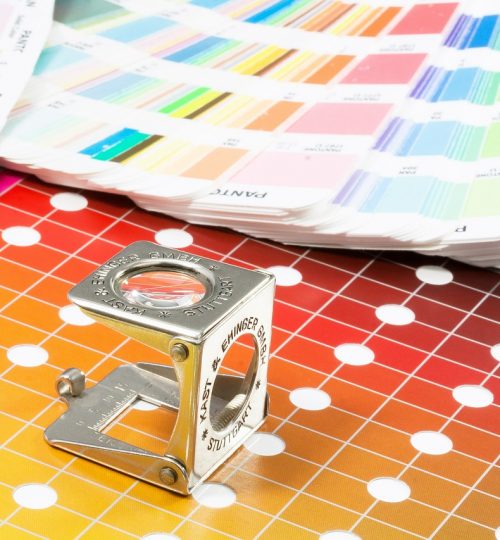
- Pantone Matching System specifications for spot-color reference
- Thread equivalents for embroidery production
- Approved garment colors and background combinations
For screen printing, a Pantone reference, usually a coated or uncoated swatch selected according to the application, can guide spot-ink matching. The final appearance can still be influenced by the garment color, ink formulation, fabric, curing, and viewing conditions, so a production proof is valuable for important brand colors.
For embroidery, thread is matched as closely as practical to the approved Pantone reference using a manufacturer’s thread chart, such as Madeira or Gunold equivalents. Thread cannot reproduce every Pantone color exactly, so your brand guide should identify acceptable substitutions.
Big T Printing can help connect your logo files, ink choices, thread colors, garment colors, and finished samples into one consistent production plan.
What apparel specifications should a brand system define?
A production-ready brand system should define garment material, weight, color, decoration method, placement, and approved logo size.
Common apparel specifications include:
- Lightweight T-shirts: approximately 4 to 4.5 ounces, often cotton blends or tri-blends
- Standard cotton T-shirts: approximately 5 to 6 ounces, commonly 100% cotton or cotton-rich
- Heavyweight shirts and sweatshirts: approximately 6 to 10 ounces for a more substantial feel
- Performance polos: often polyester or polyester blends, commonly around 4 to 6 ounces
- Premium polos and outerwear: often 5 to 7 ounces, with structured fabrics suited to embroidery
These are general industry ranges, not guarantees for every style. Fabric matters because cotton, polyester, fleece, canvas, and performance materials respond differently to ink, thread, heat, and tension.
For example, embroidery often works especially well on polos, jackets, hats, bags, and structured workwear. Screen printing is commonly effective on T-shirts, sweatshirts, team apparel, event garments, and high-volume campaigns.
Big T Printing’s St. Petersburg printing services include T-shirt printing, embroidery, hats, sweatshirts, signs, banners, decals, posters, and marketing materials.
Why does branded merchandise build brand awareness?
Branded merchandise builds brand awareness by placing your visual identity into repeated, useful moments in people’s daily lives.
A promotional item that gets used repeatedly creates more opportunities for recognition than an item that is immediately discarded. A branded tumbler on a desk, a company hat at a community event, or a well-designed polo worn by an employee keeps your business visible.
The same principle applies to corporate branded merchandise. Consistency helps people connect separate experiences:
- They see your logo on an employee’s polo.
- They recognize the same color palette on your trade show banner.
- They notice the same brandmark on a hat or promotional pen.
- They remember the same business when they need your service.
Big T Printing has access to millions of promotional products sourced globally, including drinkware, koozies, pens, stickers, bags, hats, and more. We can help you choose useful items that fit your audience and budget through our promotional products department and promotional search engine.
How much should a small business budget for branded merchandise?
A small business can begin with a focused branded merchandise program of approximately $250 to $750, while larger programs may range from $750 to $2,500 or more.
Typical planning tiers may look like this:
- Starter tier: $250–$750: 12–36 decorated garments, basic business cards, or a small promotional item order
- Growth tier: $750–$2,500: 36–144 apparel pieces, coordinated hats or polos, and event merchandise
- Brand program tier: $2,500+: uniforms, multiple garment styles, promotional products, signage, packaging, or recurring fulfillment
Actual pricing depends on garment quality, quantities, decoration method, stitch count, number of print colors, artwork preparation, shipping, and deadlines. Ordering a coordinated program can also help prevent inconsistent one-off purchases later.
Big T Printing offers low-minimum options for small businesses and start-ups, while also supporting complex corporate and organizational accounts.
How do you manage branded merchandise as your business grows?
You manage a growing merchandise program by centralizing artwork, approvals, product standards, ordering, and fulfillment.
A simple system should include:
- One approved master logo package
- A color guide with Pantone and thread references
- Standard garment styles and colors
- Placement and sizing diagrams
- A proofing process before production
- An inventory or reorder plan
- A dedicated online store when multiple people need to order
Big T Printing can handle design, proofing, production, logistics, promotional product sourcing, and online stores that simplify distribution. Promotional product orders commonly require two to four weeks, depending on the product and decoration. Decorated apparel often requires approximately 7 to 10 business days after artwork and product approvals, although timing varies by order size and production schedule.
Starting early is especially important for conferences, school programs, employee onboarding, and seasonal campaigns.
What should be included in a production-ready brand guide?
A production-ready brand guide should explain not only how your brand looks, but also how it should be manufactured.
Include:
- Brand purpose, audience, personality, and voice
- Primary, secondary, one-color, and reversed logos
- Minimum sizes and clear-space rules
- HEX, RGB, CMYK, and Pantone color values
- Approved thread color equivalents
- Typography and minimum text-size guidance
- Screen-printing color and garment rules
- Embroidery sizing, stitch, and placement guidance
- Standard left-chest, center-chest, sleeve, hat, and back placements
- Approved apparel fabrics, weights, and colors
- Promotional product imprint rules
- Examples of correct and incorrect usage
This guide becomes a practical handoff between your marketing team and your production partner. It gives everyone the same answer when questions arise.
What is the difference between brand identity and brand awareness?
Brand identity is how your business presents itself, while brand awareness is how well people recognize and remember it.
Your logo, colors, typography, apparel, messaging, and imagery make up your brand identity. Brand awareness develops when people repeatedly encounter and recognize those elements.
How do I pick the right brand colors?
Choose brand colors based on your audience, positioning, contrast needs, and ability to reproduce the colors across digital, print, ink, and thread.
Select a primary color, one or two supporting colors, and neutral shades. Then document their HEX, RGB, CMYK, and Pantone references before ordering merchandise.
What is the minimum order for custom branded apparel?
There is no single minimum order for every apparel project because minimums vary by decoration method, garment, and design.
Big T Printing offers low-minimum options for small businesses and start-ups, while larger quantities can improve per-piece pricing. Ask for a recommendation based on your garment type, deadline, and budget.
How much does a standard embroidered logo cost?
The cost of an embroidered logo depends on the garment, stitch count, quantity, digitizing, and number of locations.
As a planning reference, Big T Printing notes that a performance polo with a bold embroidered logo can sometimes be produced for under $20, depending on the selected garment and project details.
How long does custom apparel production take?
A typical decorated apparel project may take approximately 7 to 10 business days after final approval, but the confirmed timeline depends on the order.
Rush needs, specialty garments, complex artwork, large quantities, and inventory availability can change the schedule.
What file format is best for a logo used on apparel?
Vector artwork such as AI, EPS, or SVG is usually the best master format because it can be scaled without losing quality.
A high-resolution PNG may work for some applications, but vector files give the production team more control over sizing, color separation, and embroidery preparation.
Can the same logo be used for screen printing and embroidery?
The same core logo can support both methods, but embroidery may require a simplified or slightly modified production version.
A professional production review can identify fine details, small lettering, or color combinations that need adjustment before decoration.
Where does Big T Printing serve?
Big T Printing serves customers in the Tampa Bay area, including St. Petersburg and Largo, as well as businesses and organizations nationwide.
Our team works from 2801 16th Street North, St. Petersburg, FL 33704, and supports local pickup, nationwide projects, promotional product distribution, and online store fulfillment. If you are searching for screen printing Tampa, embroidery, or a full branding partner, contact Big T Printing to discuss your next project.